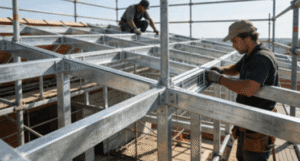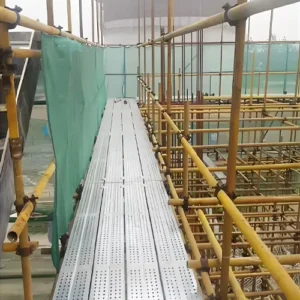
Selecting the appropriate scaffolding system is a critical decision that directly impacts construction safety, operational efficiency, project costs, and on-schedule completion. With a variety of scaffolding types available—including ringlock, coupler, mobile, and frame scaffolding—each designed for specific scenarios, it’s essential to align the selection with your project’s unique characteristics. This article outlines key considerations and a step-by-step guide to help construction teams and buyers choose the right scaffolding for their needs.
Evaluate Project Scenarios and Environmental Conditions
The first and foremost factor in scaffolding selection is understanding the project’s core scenario and surrounding environment. High-rise building construction, for instance, demands systems with exceptional stability, load-bearing capacity, and wind resistance—making ringlock scaffolding the optimal choice due to its axial force transmission and modular rigidity. For bridge or viaduct projects with complex terrain and curved structures, coupler scaffolding offers unmatched flexibility to adapt to irregular shapes and slope variations.
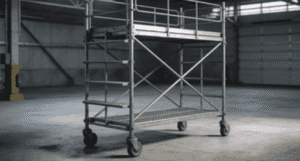
Environmental conditions also play a pivotal role. In high-temperature, high-humidity regions (such as the Middle East or Southeast Asia), scaffolding with anti-corrosion galvanized treatment should be prioritized to extend service life. For cold or coastal areas prone to salt spray, materials with enhanced rust-proof performance are necessary. Additionally, indoor projects like factory maintenance or interior renovation can benefit from mobile scaffolding, which offers easy maneuverability and quick deployment.
Assess Load-Bearing Requirements and Safety Standards
Load-bearing capacity is a non-negotiable criterion, as it directly relates to construction safety. Calculate the total load the scaffolding must support, including the weight of workers, construction materials, tools, and environmental loads (such as wind or snow). For heavy-load scenarios like concrete pouring or steel structure installation, ringlock scaffolding or reinforced frame scaffolding with high load-bearing limits (up to 20kN per vertical rod) is suitable. Light-load tasks, such as painting or small-scale maintenance, can use lightweight mobile scaffolding to optimize efficiency and cost.
Simultaneously, ensure the selected scaffolding complies with local and international safety standards, such as EN 12811 (Europe), ANSI A10.8 (US), and JGJ 130 (China). Verify that the manufacturer provides certification for material quality, welding processes, and structural safety—avoid substandard products that fail to meet these norms, as they pose severe safety hazards.
Consider Construction Efficiency and Operational Flexibility
Project timelines and operational needs should guide the selection of scaffolding types to maximize efficiency. Modular systems like ringlock and frame scaffolding feature standardized components that enable quick assembly and disassembly, reducing construction preparation time by 30% or more compared to traditional systems. This is particularly beneficial for large-scale projects with tight schedules.
Flexibility is another key consideration for projects with changing work areas or irregular structures. Mobile scaffolding with lockable casters allows for easy relocation between workstations, ideal for factory equipment maintenance or subway station renovation. Coupler scaffolding, with its adjustable connections, can be freely combined to fit unique project contours, eliminating the need for custom components in most cases.
Factor in Cost-Effectiveness and Sustainability
Cost-effectiveness extends beyond the initial purchase price—it encompasses long-term maintenance, reuse potential, and lifecycle costs. Durable scaffolding made of high-grade steel may have a higher upfront cost but offers extended service life and multiple reuse opportunities, reducing overall project expenses. For example, galvanized ringlock scaffolding can be reused across multiple projects with minimal maintenance, making it a cost-efficient choice for long-term operations.
Sustainability is also increasingly important in modern construction. Choose scaffolding systems that are recyclable and reusable, such as steel scaffolding, to align with green building goals. Avoid disposable or non-recyclable materials that contribute to waste. Additionally, modular designs that reduce material waste during assembly and disassembly further enhance the project’s environmental performance.
Partner with a Reliable Manufacturer for Customized Solutions
For projects with unique requirements—such as historic building restoration, curved roof construction, or ultra-large-span structures—standard scaffolding systems may not suffice. In such cases, partnering with a manufacturer capable of providing customized solutions is essential. A professional manufacturer can conduct on-site assessments, perform structural calculations, and design tailor-made scaffolding systems that meet specific load, shape, and safety requirements.
When selecting a manufacturer, prioritize those with rich industry experience, a complete quality control system, and global project case studies. Ensure they offer comprehensive after-sales services, including installation guidance, technical training, and maintenance support—these services are critical for ensuring the scaffolding is used correctly and safely.
Conclusion
Choosing the right scaffolding is a systematic process that requires balancing safety, efficiency, cost, and project-specific needs. By evaluating project scenarios, load-bearing requirements, operational flexibility, and sustainability goals, and partnering with a reliable manufacturer, construction teams can select a scaffolding system that not only meets regulatory standards but also optimizes project outcomes.
In an industry where safety and efficiency are paramount, investing time in selecting the appropriate scaffolding is an investment in the project’s success. With the right system in place, construction teams can mitigate risks, accelerate progress, and achieve optimal results across diverse project types.