As a core supporting equipment in construction, municipal infrastructure, high-altitude operations and other scenarios, scaffolding quality directly affects construction safety, project progress and operational efficiency. A high-quality scaffolding system requires a full-cycle quality control process, covering raw material selection, production process supervision, structural design standardization, erection specifications, and post-use inspection and maintenance. This article explores the five core factors that determine scaffolding quality, providing professional references for global construction procurement and construction teams.
Raw Material Quality: The Fundamental Cornerstone
Raw material quality is the primary determinant of scaffolding load-bearing capacity and overall stability. Core components such as steel pipes should be made of high-quality steel that meets national and international standards, such as Q235 and Q345 low-alloy high-strength steel. Strict adherence to specified pipe diameter and wall thickness is mandatory—substandard steel pipes with reduced wall thickness or mixed materials drastically compromise axial compression capacity, posing severe safety risks.
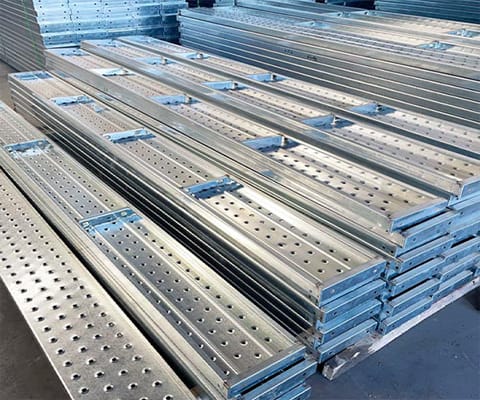
Couplers, as critical connection parts, must be free of cracks, with standard wall thickness and well-fastened bolts without slipping threads. Defective couplers directly weaken connection strength, increasing the risk of loosening or collapse. Meanwhile, supporting products like steel planks and adjustable steel props should maintain consistent quality standards to ensure overall system reliability.
Precision Production & Standardized Design: Core Guarantee
High-quality scaffolding production relies on rigorous processing standards. Steel pipe cutting and welding must comply with ISO 3834 welding quality requirements to avoid weld cracks, rod bending and deformation. Node design is particularly crucial for mainstream scaffolding types—for example, the axial force-bearing design of ringlock scaffolding enables linear load transmission, reducing bending moment effects.
Standardized modular production ensures component dimensional accuracy, enhancing assembly fit and stability. Additionally, anti-corrosion and rust-proof treatments (such as professional galvanizing and painting) are essential to resist wear and corrosion in complex construction environments, extending the scaffolding service life.
Scientific Structural Design: Key Prerequisite for Safety
Structural design must align with actual project conditions, incorporating factors such as construction height, span and load requirements for special force calculation. Blindly copying designs or relying on experience is prohibited. Rational planning of vertical and horizontal rod spacing, as well as verticality and levelness control, is mandatory.
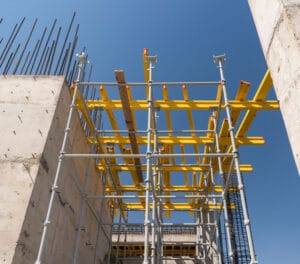
Installation of bottom rails, diagonal braces and cross braces strengthens overall stability and lateral displacement resistance—for instance, diagonal braces should cover no less than 4 spans with an inclination angle of 45°~60° to effectively transfer horizontal forces and prevent overturning. Adjustable jacks and bases must support precise height adjustment, with strict limits on screw extension and cantilever length to avoid force imbalance.
Standardized Erection & Installation: Critical Implementation Link
Standardized erection translates design and material advantages into practical safety. Construction must comply with special construction plans and international safety standards such as JGJ 130 and EN 12811. Vertical rod splicing should use butt couplers, with bolt torque controlled between 40N·m~65N·m; ringlock scaffold pins must be hammered into locked positions.
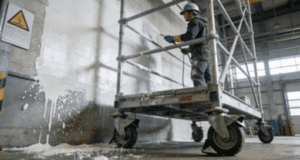
Scaffolding foundations require firmness, flatness and sufficient load-bearing capacity, with base plates or sockets installed at the bottom and effective drainage measures in place to prevent settlement. Tall scaffolding systems must be rigidly connected to building structures, and template supports shall not be mixed with external scaffolding. Professional training for construction teams is also vital to ensure precise operation and avoid instability caused by improper practices.
Strict Quality Inspection & Post-Maintenance: Lifecycle Protection
Phased inspections are mandatory—unqualified raw materials must be rejected before delivery and erection. After installation, a three-level acceptance system (team self-inspection, project re-inspection, third-party sampling inspection) verifies key indicators such as vertical rod verticality, node firmness and protective measures.
As turnover materials, scaffolding is prone to rust, wear and loose couplers after repeated use. Regular maintenance, including component replacement and anti-rust treatment, is necessary. Real-time monitoring of load-bearing and deformation during use, as well as re-inspection after severe weather (such as strong winds and heavy rains), ensures ongoing safety.
Conclusion
Scaffolding quality control is a systematic project where the five core factors are interrelated and indispensable. For the construction industry, selecting manufacturers with sound quality management systems and adhering to standardized design, construction and inspection processes is the fundamental way to ensure scaffolding safety. With the industry’s transformation towards industrialization and intelligence, new technologies such as BIM pre-assembly and intelligent monitoring systems will further enhance quality control levels, laying a solid foundation for construction safety worldwide.