Table of Contents
Introduction
A rolling scaffold can make work at height considerably more efficient when crews need a stable working platform that can be repositioned between different work areas. It is widely used for installation, renovation, painting, electrical work, facility maintenance and other tasks where repeatedly dismantling a fixed scaffold would interrupt productivity.
Mobility, however, changes the way a scaffold should be selected.
A rolling scaffold does not become suitable simply because wheels have been added to a scaffolding frame. The base dimensions, working height, caster design, platform arrangement, bracing, outriggers, access system and ground conditions all contribute to how safely and efficiently the tower can be used.
For procurement teams, another challenge is separating useful specifications from superficial product descriptions. Two mobile scaffolds may look similar in a product photograph while differing significantly in frame dimensions, caster capacity, platform configuration, connection details and intended working conditions.
This buying guide explains how contractors, distributors and project teams can evaluate rolling scaffolding according to real construction requirements. It also covers the factors that should be discussed with a manufacturer before an order is finalized.
Zichen’s mobile scaffolding solution uses a walk-through frame structure with self-locking casters, adjustable base components and reinforced bracing for projects that require frequent relocation. The most appropriate configuration should nevertheless always be determined from the conditions of the individual project.
What Is a Rolling Scaffold?
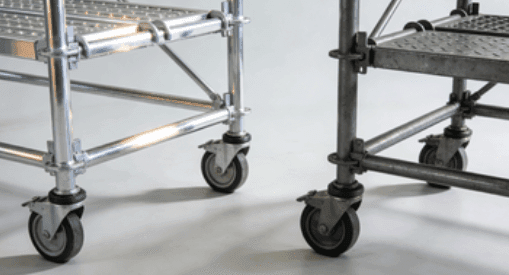
A rolling scaffold is a supported scaffold installed on wheels or casters so that the complete structure can be repositioned without being fully dismantled.
It may also be described as:
- Rolling scaffolding
- Mobile scaffolding
- Mobile scaffold tower
- Rolling tower
- Mobile access scaffold
The basic system normally combines a scaffolding frame or modular structure with working platforms, horizontal and diagonal braces, guardrails, access components and scaffold wheels.
According to the OSHA guidance for mobile scaffolds, mobile scaffolds are supported scaffolds mounted on casters or wheels and are commonly used for activities where workers need to change position regularly.
The important difference between rolling scaffolding and conventional fixed scaffolding is therefore not simply the wheel itself. It is the ability of the entire scaffold to be safely repositioned while maintaining the structural features required for working at height.
Where Does Rolling Scaffolding Make the Most Sense?
Rolling scaffolding is most effective when the work area changes regularly but remains within an environment where the scaffold can be moved safely.
Typical applications include maintenance inside factories, electrical and mechanical installation, warehouse work, commercial building renovation, ceiling installation, painting, lighting work and equipment servicing.
Imagine a contractor installing overhead mechanical equipment across a large production workshop. A fixed scaffold may need to be dismantled and reconstructed several times as the work progresses across the building. A properly selected mobile scaffold allows the crew to complete one section, relocate the working tower and continue with less interruption.
The same logic applies to shopping centers, warehouses, exhibition halls and other large interior spaces.
Zichen’s mobile scaffolding is positioned for applications including building engineering, industrial maintenance, power projects and municipal work where a movable working platform can improve operational flexibility.
Rolling scaffolds are not automatically the right solution for every project. Soft ground, steep slopes, major surface irregularities, restricted movement paths, strong wind exposure or extremely complex structures may make another scaffolding arrangement more appropriate.
Start With the Required Working Height
Working height should be established before selecting frame dimensions, scaffold wheels or accessories.
Buyers should distinguish between the height of the scaffold itself and the elevation from which workers actually perform their tasks.
For example, a project may require access to equipment 8 meters above the floor, but this does not automatically mean an 8-meter platform is required. Worker reach, platform height, guardrail height and access arrangements all influence the final tower configuration.
As the tower becomes taller, stability becomes increasingly important. A narrow tower that works effectively at a low elevation may require a larger base, stabilizers, outriggers or a different configuration when erected higher.
Do not purchase a rolling scaffold by specifying height alone.
Provide the manufacturer with:
- Required platform height
- Required working height
- Scaffold width
- Scaffold length
- Indoor or outdoor use
- Ground conditions
- Planned movement conditions
This information makes it possible to evaluate the tower as a complete structure.
Why the Height-to-Base Relationship Matters
A mobile tower must remain stable both while workers are using it and when movement is permitted.
A taller structure creates greater overturning leverage, particularly if the base is narrow. Environmental forces, uneven movement, platform loading and workers shifting position can also influence stability.
For U.S. construction, OSHA establishes specific requirements for mobile scaffolds and requires them to be stabilized against tipping during movement. Its rules also address the height-to-base-width relationship when personnel remain on a scaffold while it is being moved.
The practical procurement lesson is simple: do not maximize tower height without considering the footprint of the scaffold.
A buyer who focuses only on obtaining the tallest possible mobile scaffold from a compact base may create unnecessary operational restrictions or require additional stabilizing components.
Zichen’s current mobile scaffold specifications identify different stability limits for movement and stationary use. Project teams should confirm the exact configuration and operating instructions applicable to the model being ordered rather than applying one ratio to every tower.
Scaffold Wheels and Casters Deserve More Attention
Scaffold wheels are sometimes treated as minor accessories. On rolling scaffolding, they are fundamental structural and operational components.
A suitable caster must carry the loads transferred through the scaffold legs while also providing reliable movement and locking behavior.
When reviewing scaffolding casters, buyers should examine:
- Wheel diameter
- Rated load
- Wheel material
- Stem design
- Brake or locking mechanism
- Swivel function
- Connection to the scaffold leg
- Suitability for the intended floor
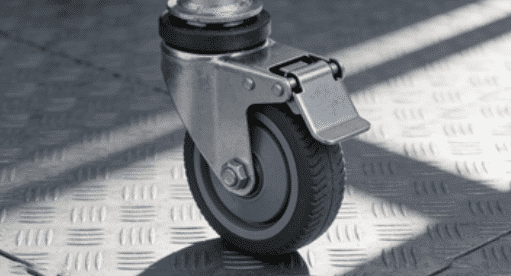
Zichen’s mobile scaffold product is currently configured with 5-inch self-locking casters, and the product information specifies a caster load capacity of at least 5 kN. Project requirements should still be confirmed before ordering because the caster is only one part of the complete load path.
For U.S. projects, OSHA mobile scaffold requirements state that casters and wheels must be locked with positive wheel locks, wheel-and-swivel locks or equivalent means while the scaffold is being used in a stationary position.
OSHA also requires caster and wheel stems to be pinned or otherwise secured in scaffold legs or adjustment screws.
A procurement specification should therefore describe more than “four wheels included.”
Choose Casters According to the Floor
The working surface has a major influence on caster selection.
A rolling scaffold operating on a smooth concrete factory floor faces different conditions from a tower moving over a rough renovation site.
Before choosing the wheel arrangement, evaluate:
- Floor hardness
- Surface smoothness
- Small joints or gaps
- Thresholds
- Debris
- Floor coatings
- Drainage channels
- Slopes
- Surface load limitations
Larger wheels may pass over small irregularities more easily, while certain wheel materials may be preferred where finished flooring must be protected.
However, no caster should be expected to compensate for an unsuitable movement path.
OSHA requires the surface to meet specific conditions when a mobile scaffold is moved with workers aboard under circumstances permitted by its rules. Even when no one is on the tower, holes, obstacles and significant surface irregularities should be considered before relocation.
For many projects, inspecting and clearing the movement route is just as important as selecting the caster.
Why Locking Mechanisms Matter
A rolling scaffold should roll when relocation is intended and remain stationary when work is taking place.
That sounds obvious, but inadequate caster locking is one of the most important issues to avoid.
A wheel brake or positive locking mechanism helps prevent unintended movement while workers are using the platform.
On a large interior project, the crew may relocate the tower dozens of times. This repetitive workflow can encourage shortcuts if the locking mechanism is awkward to operate or difficult to verify.
A well-selected caster system should therefore make correct operation practical.
Procurement teams can ask the manufacturer:
- How is the wheel locked?
- Is swivel movement also controlled?
- How can workers visually confirm the lock?
- How is the caster stem secured?
- What is the rated capacity?
- Can replacement casters be supplied?
Small details can significantly affect long-term usability.
Examine the Scaffolding Frame and Bracing
A mobile scaffold must remain rigid enough to resist racking and unwanted deformation.
Frame construction and bracing therefore deserve the same attention as mobility.
A typical rolling tower may incorporate:
- Main frames
- Cross braces
- Horizontal braces
- Platform supports
- Guardrail frames
- Access components
Cross bracing helps keep the scaffold squared and transfers forces through the structure.
Zichen’s rolling scaffold configuration incorporates cross braces and horizontal stiffening components as part of its frame system.
OSHA similarly requires mobile scaffolds to be plumb, level and squared, with cross, horizontal or diagonal bracing—or a suitable combination—used to prevent racking or collapse.
Missing one brace because the tower “still looks stable” is not an acceptable approach. The complete component arrangement should follow the manufacturer’s instructions and the applicable scaffold requirements.
Make Platform Selection Part of the Buying Decision
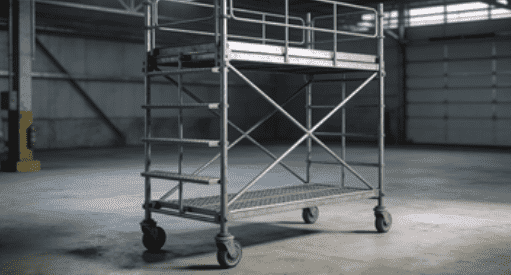
The scaffold platform is not merely a place to stand. Its dimensions and configuration directly affect how useful the tower is for the intended task.
A narrow platform may be sufficient for inspection work but inefficient where workers need tools or materials beside them. An unnecessarily large platform can increase equipment requirements and affect tower configuration.
Before ordering, determine:
- Required platform width
- Required platform length
- Number of working levels
- Access opening requirements
- Surface grip
- Expected load
- Guardrail arrangement
- Toe-board requirements
Workers should have enough room to perform the job without overcrowding the platform.
If the wider project also requires fixed scaffold working surfaces, Zichen supplies steel scaffold planks as part of its scaffolding product range.
Platform selection should always be coordinated with the specific scaffold system because decks, hooks and support dimensions are not automatically interchangeable between different products.
Do Not Create Extra Height With a Ladder on the Platform
A common misuse of mobile towers is attempting to gain additional reach by placing a ladder, box or makeshift platform on top of the scaffold platform.
This changes the worker’s position relative to the guardrails and can affect stability.
The better approach is to specify an appropriate scaffold configuration for the required working elevation from the beginning.
The UK’s Health and Safety Executive guidance on tower scaffolds specifically warns against using a tower as support for ladders or other access equipment and emphasizes selecting a tower suitable for the work.
For procurement teams, this is another reason to obtain accurate working-height information before purchasing.
A scaffold that is consistently too short will encourage inefficient or unsafe improvisation.
Guardrails Should Be Included in the System
Scaffold guard rails are essential components of the working platform arrangement.
Depending on the system and applicable regulations, edge protection can include:
- Top rails
- Intermediate rails
- Guardrail frames
- Toe boards
- Access gates
These components should be considered when preparing the bill of materials rather than added after the tower reaches the site.
A mobile tower missing the correct guardrail components is not a complete working solution.
This is especially relevant for distributors ordering scaffold systems for resale. Buyers may compare quotes based on the main frames and wheels while overlooking whether the packages include all necessary platform protection and access components.
Compare complete configurations rather than isolated frame prices.
Safe Access Is Part of a Good Rolling Scaffold Design
Workers need a defined way to enter and leave the platform.
Depending on tower design, access may involve:
- Internal ladders
- Integrated climbing frames
- Stair sections
- Trapdoor platforms
Workers should not be expected to climb the outside of an unsuitable frame simply because the platform itself appears secure.
The HSE guidance for mobile access towers identifies purpose-built platforms, guardrails and a built-in ladder or staircase among the essential safety features that should be considered for mobile access towers.
When requesting a quotation, specify how often workers will move between levels and whether they will carry tools or other small equipment. This information can affect whether ladder or stair access is more practical.
When Do Scaffolding Outriggers Matter?
Scaffolding outriggers increase the effective support footprint and can improve tower stability in configurations where they are required.
They may become important as working height increases or when the tower geometry requires additional stabilization.
However, outriggers should not be added randomly.
Their dimensions, installation position and use need to match the scaffold design and manufacturer’s instructions.
OSHA requires outrigger frames, when used under its applicable mobile scaffold provisions, to be installed on both sides in the specified movement conditions. The HSE likewise advises that stabilizers or outriggers should be installed when required by the tower instruction manual.
A buyer should ask:
- At what tower heights are outriggers required?
- Which outrigger size matches each configuration?
- Are all connecting parts included?
- Does the tower remain movable with them installed?
- What operating restrictions apply?
These questions are particularly important when the same tower will be assembled at several different heights.
Adjustable Base Components Help With Leveling, Not Bad Ground
Some mobile scaffold systems combine casters with adjustable base arrangements that allow limited leveling.
This is useful when a floor has small variations in elevation.
It does not mean a rolling scaffold can safely operate across severely uneven, unstable or soft surfaces.
OSHA’s mobile scaffold requirements specify the use of screw jacks or equivalent means where leveling is necessary.
The correct sequence is therefore:
evaluate surface → prepare movement area → level the scaffold → confirm stability
rather than relying on maximum jack extension to compensate for poor ground.
Excessive adjustment can also change tower geometry and should only be used according to the designed configuration.
Calculate the Working Load Before Ordering
Buyers frequently ask how much weight a rolling scaffold can carry, but there is no useful universal answer without knowing the specific system.
The load on the tower may include:
- Workers
- Hand tools
- Installation materials
- Components awaiting installation
- Platform self-weight
The complete scaffold structure must accommodate the intended loading.
Do not assume that because an individual caster has a certain capacity, multiplying that capacity by four gives the usable platform load. Structural capacity is affected by the entire load path, including the frames, braces, platforms, connections and base arrangement.
When requesting technical information, tell the supplier what will actually be placed on the platform.
A painting crew, an electrical maintenance team and a mechanical installation crew may have very different load requirements even when working at the same height.
Indoor Scaffolding Has Different Priorities
Indoor scaffolding is one of the strongest applications for rolling towers.
Wind exposure is generally lower than outdoors, surfaces may be smoother and crews often need to move between many work points.
Typical applications include:
- Warehouse maintenance
- Ceiling installation
- Lighting replacement
- Electrical work
- HVAC installation
- Factory equipment maintenance
- Shopping mall renovation
- Painting and decorating
For indoor use, purchasing priorities often shift toward compact width, caster quality, maneuverability, assembly efficiency and protection of finished flooring.
Doorways and aisle widths should also be measured.
A tower that is easy to roll but too wide to pass through the project’s main access routes may still require frequent dismantling, eliminating much of the productivity benefit.
Outdoor Rolling Scaffolding Requires More Planning
Mobile scaffolds can also be used outdoors in appropriate conditions, but the operating environment needs closer attention.
Outdoor considerations include:
- Wind
- Rain
- Ground variation
- Slopes
- Open edges
- Vehicle traffic
- Pedestrian traffic
- Overhead electrical hazards
- Surface debris
Wind can be particularly important because scaffold towers have relatively large exposed structures.
Adding sheeting, banners or other materials can dramatically change wind loading and should not be done without considering the scaffold design.
The HSE tower scaffold guidance warns against using towers in strong winds and highlights the need to check overhead obstructions and ground conditions before moving a tower.
Where an outdoor project requires a large, tall or long-term access structure, a fixed scaffolding system may offer a more appropriate solution.
Rolling Scaffold vs Fixed Scaffold
The main advantage of a rolling scaffold is mobility, but mobility is only valuable when the project actually benefits from it.
| Project Factor | Rolling Scaffold | Fixed Scaffold |
|---|---|---|
| Frequent relocation | Excellent fit | Requires rebuilding or extension |
| Large continuous façade | Less efficient in many cases | Often more suitable |
| Indoor maintenance | Strong application | May be unnecessarily complex |
| High-rise exterior work | Limited to suitable configurations | Usually more appropriate |
| Compact work areas | Useful where movement paths allow | Depends on layout |
| Long-term continuous access | May offer little mobility benefit | Strong application |
| Repeated short-duration tasks | Highly practical | Often less efficient |
A factory carrying out maintenance at fifteen separate ceiling locations does not have the same access requirement as a contractor working continuously across a high-rise façade.
Equipment selection should follow workflow.
Rolling Scaffold vs Ladder
For brief, low-risk tasks, ladders may be appropriate where a risk assessment supports their use. For work requiring both hands, longer working periods, tools or greater lateral working space, a scaffold platform may provide significant practical advantages.
A rolling scaffold can provide:
- A larger working surface
- Guardrail protection
- Space for tools
- More stable worker positioning
- Repositioning between work zones
This does not mean a rolling scaffold automatically replaces every ladder.
The HSE work-at-height guidance recommends selecting work equipment according to the risk and task, with collective protection prioritized where reasonably practicable.
The duration and nature of the work should therefore influence the access method.
How to Move Rolling Scaffolding Correctly
Mobility can create risk if workers treat a scaffold tower like a trolley.
Before moving, check:
- The planned route
- Ground condition
- Overhead obstacles
- Loose materials
- Tools on the platform
- Scaffold stability
- Caster condition
- Applicable manufacturer instructions
OSHA requires mobile scaffolds to be stabilized against tipping during movement and specifies how manual force should be applied under its U.S. construction rules.
Importantly, rules concerning workers remaining on a mobile scaffold during movement are conditional and jurisdiction-specific. Project teams should not assume that keeping personnel on a moving tower is generally acceptable.
A simple operating procedure is often more effective: stop work, clear or secure materials as required, relocate the scaffold according to the manufacturer’s instructions, lock the casters, verify the tower and resume work.
Why “Easy to Assemble” Should Be Examined Carefully
Fast assembly is a meaningful advantage, but marketing claims should be interpreted within the actual configuration.
Zichen’s mobile scaffold product page identifies tool-free assembly and states that a specified 10 m² platform configuration can be assembled by two workers within the stated timeframe.
The important procurement question is whether the same efficiency applies to the configuration your project requires.
A taller tower with multiple platforms, outriggers and guardrails naturally contains more components than a basic unit.
Ask the supplier for:
- Assembly drawings
- Component list
- Installation manual
- Recommended assembly sequence
- Required tools
- Crew requirements
The objective is not simply to achieve the smallest theoretical assembly time. It is to create a repeatable process that site crews can understand and follow.
Check Whether Replacement Parts Will Be Available
Scaffolding is normally purchased for repeated use.
Casters, locking components, platforms and braces may eventually need inspection or replacement.
Before placing a large order, consider whether the supplier can provide compatible replacement parts in the future.
Important spare components may include:
- Scaffold wheels
- Caster brakes
- Pins
- Braces
- Platforms
- Guardrail components
- Adjustable bases
This is particularly important for rental companies and distributors that expect the equipment to circulate through multiple projects.
A low initial price becomes less attractive if a small damaged component makes an entire scaffold tower unusable because compatible replacements cannot be sourced.
What International Buyers Should Put in an RFQ
A useful RFQ for rolling scaffolding should contain enough information for the supplier to recommend a configuration rather than guess.
Include:
- Required working height
- Platform height
- Platform dimensions
- Number of towers
- Indoor or outdoor application
- Main construction task
- Maximum expected platform load
- Floor or ground description
- Whether the tower must pass through doors or aisles
- Required caster characteristics
- Need for adjustable bases
- Need for outriggers
- Guardrail requirements
- Access requirements
- Destination country
- Applicable standards
- Packaging requirements
Drawings or photographs can also help when the working environment is unusual.
If the specification is not yet complete, buyers can send project requirements to Zichen so the proposed mobile scaffold configuration can be discussed before quantities are finalized.
What to Check Before Accepting a Supplier’s Proposal
Once a quotation is received, do not compare only the final total.
Check exactly what is included.
A complete review should cover:
| Item | Questions to Ask |
|---|---|
| Main frame | What are the dimensions and material specifications? |
| Casters | What diameter, capacity and locking system are used? |
| Bracing | Are all required braces included? |
| Platform | What dimensions and working load apply? |
| Guardrails | Is complete edge protection supplied? |
| Access | Is an internal ladder, stair or access platform included? |
| Outriggers | When are they required and are they included? |
| Base adjustment | What adjustment range is permitted? |
| Finish | What corrosion-protection process is used? |
| Documentation | Are assembly and operating instructions available? |
| Spare parts | Can compatible replacements be ordered later? |
This comparison reveals differences that a simple unit-price table can hide.
Common Rolling Scaffold Buying Mistakes
One frequent mistake is choosing the tallest available tower without considering base dimensions or stabilizing requirements. Height should always be assessed as part of the complete configuration.
Another mistake is focusing on scaffold frames while treating casters, guardrails and platforms as secondary accessories. A mobile tower depends on all of these components.
Buyers also sometimes overlook access. An excellent working platform is less useful if workers do not have a practical and compliant way to reach it.
Another problem is assuming that rolling scaffolding can travel over any construction surface. Mobility depends heavily on a firm, suitable movement path.
Finally, many procurement teams compare only initial product cost. Long-term value also depends on assembly efficiency, component durability, replacement-part availability and how often the tower can be reused across future projects.
How Zichen Mobile Scaffolding Fits Project Applications
Cangzhou Zichen Building Materials manufactures scaffolding and supporting products for building, industrial and infrastructure applications. Its current product portfolio includes mobile scaffolding, ringlock scaffolding, steel planks, couplers and adjustable steel props.
The company’s mobile scaffolding system uses a walk-through frame configuration with cross bracing, horizontal reinforcement, self-locking casters and adjustable base components.
This type of configuration is relevant for contractors that need movable access for renovation, installation or maintenance rather than a permanent temporary structure covering an entire façade.
For projects where a rolling tower is only one part of a larger access system, buyers can also review Zichen’s complete scaffolding product range to coordinate supporting components through the same procurement process.
The final configuration should always be based on actual project height, loads, ground conditions, mobility requirements and destination-market requirements.
Frequently Asked Questions
What is a rolling scaffold?
A rolling scaffold is a supported scaffolding structure mounted on casters or wheels so it can be relocated between work areas. It normally consists of frames or modular structural components, braces, platforms, guardrails, access equipment and locking casters.
What is the difference between rolling and mobile scaffolding?
The terms are commonly used to describe the same general category of movable scaffold. Product designs vary, so buyers should focus on the actual frame, caster, platform, bracing and stability specifications rather than terminology alone.
Should scaffold wheels be locked while people are working?
For projects governed by OSHA construction requirements in the United States, mobile scaffold casters and wheels must be locked with positive wheel locks, wheel-and-swivel locks or equivalent means while the scaffold is used in a stationary position. Other jurisdictions may impose their own requirements.
When are scaffolding outriggers required?
Outrigger requirements depend on tower design, height, base dimensions, operating conditions and applicable instructions or regulations. Buyers should follow the manufacturer’s specified tower configurations rather than adding or removing outriggers independently.
Is rolling scaffolding suitable for indoor work?
Yes. Indoor maintenance, mechanical and electrical installation, ceiling work, painting, warehouse operations and factory maintenance are common applications because the tower can be moved between working locations when surface conditions permit.
Can rolling scaffolding be used outdoors?
It can be suitable for certain outdoor applications, but wind, ground conditions, slopes, obstacles and surrounding activity need to be assessed carefully. Fixed scaffolding may be more appropriate for large or long-duration external work.
Can workers stay on a rolling scaffold while it is moved?
Rules depend on the jurisdiction and circumstances. OSHA permits this only when specific conditions in its mobile scaffold requirements are satisfied. A project should follow applicable regulations and the manufacturer’s operating instructions rather than assuming workers may remain on the tower.
Are bigger scaffold wheels always better?
No. Wheel diameter is only one consideration. Caster load capacity, locking performance, stem connection, floor conditions and the overall scaffold configuration also matter.
How do I calculate the correct rolling scaffold height?
Begin with the required work elevation and platform level rather than simply the building height. Account for worker reach, guardrails, base adjustments and the approved tower configuration. The supplier should receive the actual project dimensions before recommending component quantities.
What information should I send to a rolling scaffold manufacturer?
Provide working height, platform dimensions, expected loads, application, movement frequency, surface conditions, indoor or outdoor use, access requirements, destination country and required quantities. Drawings and site photographs can improve the accuracy of the proposed configuration.
Conclusion
A rolling scaffold should be purchased as a complete mobile access system, not simply as a scaffolding frame fitted with wheels.
The right configuration brings together working height, base dimensions, caster performance, bracing, scaffold platform design, guardrails, access and outriggers in a system suited to the actual work environment.
For contractors, the strongest advantage of rolling scaffolding is the ability to move a stable working platform between multiple work locations without repeatedly dismantling a fixed scaffold. This can be particularly valuable for indoor installation, industrial maintenance, renovation and other projects where work progresses across a large area.
That advantage disappears, however, if the tower is too large for the movement path, unsuitable for the floor, difficult to stabilize or incomplete when it reaches the site.
Procurement should therefore begin with project conditions. Establish the working height, load, movement route, platform requirements and applicable safety rules first, and then select the scaffold configuration.
Authoritative resources such as the OSHA mobile scaffold guidance and HSE tower scaffold guidance provide useful safety references, while the manufacturer’s instructions should define the approved configuration and assembly requirements for the specific product.
For B2B procurement, Zichen provides mobile scaffolding and related scaffold systems for different construction applications. Buyers with specific dimensions, loads or project requirements can contact Zichen to discuss the appropriate component configuration before placing an order.