Table of Contents
Indoor construction and maintenance work is becoming more specialized. Contractors are expected to complete projects faster, work safely in occupied buildings, protect finished surfaces, and move equipment through narrow spaces.
These demands are encouraging more professionals to replace basic ladders and improvised platforms with purpose-built indoor scaffolding. Modern systems provide a larger working platform, better mobility, adjustable working heights, and space for tools and materials.
Key Takeaways
- Indoor scaffolding creates a more stable and practical elevated workspace than a standard ladder.
- Mobile and folding systems can be moved between rooms with less dismantling.
- Modular components help contractors adjust platform height and configuration.
- Lockable casters improve mobility while supporting controlled positioning.
- The right system can reduce repeated climbing, repositioning, and work interruptions.
- Buyers should compare dimensions, load capacity, platform design, access methods, and safety components.
- Indoor scaffolds are commonly used for painting, drywall installation, electrical work, HVAC maintenance, ceiling repair, and warehouse operations.
- Scaffolding must always be selected, assembled, inspected, and used according to local regulations and manufacturer instructions.
What Is Indoor Scaffolding?
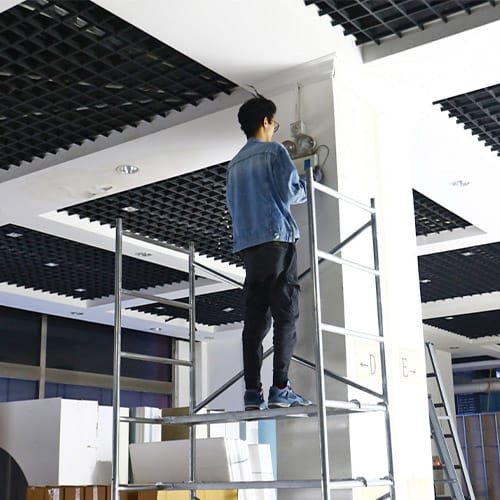
Indoor scaffolding is a temporary elevated work platform designed or configured for work inside buildings. It allows workers, tools, and materials to be positioned at a suitable height during construction, repair, installation, decoration, and facility maintenance.
Unlike large façade systems, indoor units are generally designed around limited floor space, standard door openings, finished surfaces, and frequent repositioning. Many systems use compact frames, adjustable platforms, folding structures, access ladders, guardrails, and lockable wheels.
According to the general definition provided by Wikipedia’s overview of scaffolding, scaffolding is a temporary structure used to support workers and materials while providing access to areas that would otherwise be difficult to reach.
A Working Platform, Not Just Access Equipment
A ladder mainly provides access to a height. A scaffold provides an elevated area where a worker can stand, move, place tools, and perform a task.
This distinction becomes important during jobs that require both hands, repeated horizontal movement, or extended working time.
A Configurable Access System
Indoor scaffolding is not a single product design. It can include folding scaffolds, mobile towers, frame scaffolds, ladder scaffolds, low-level platforms, and modular systems.
The most appropriate configuration depends on the ceiling height, floor condition, doorway width, task duration, working load, and available assembly space.
Why Indoor Scaffolding Is Gaining Popularity in 2026
The growing use of indoor access systems is connected to changes in how commercial, residential, and industrial projects are managed.
Professionals increasingly evaluate equipment according to total job-site efficiency rather than purchase price alone.
1. Contractors Need More Productive Work Platforms
A wide platform gives workers more room to organize tools and complete tasks without climbing down after every small movement.
For painting, drywall finishing, electrical installation, and ceiling work, reducing unnecessary climbing can improve workflow and limit interruptions.
Fewer Repositioning Cycles
A ladder may need to be moved every time the worker reaches the edge of a small working zone. A mobile scaffold can cover a wider section before repositioning is required.
The actual productivity benefit depends on the task, room layout, scaffold length, and site procedures.
2. Indoor Projects Require Better Mobility
Modern commercial interiors often include corridors, multiple rooms, open-plan areas, and changing work zones. Equipment that is difficult to relocate can slow down a crew.
Mobile systems fitted with suitable scaffolding casters can be repositioned more efficiently when the platform is unoccupied and the movement follows applicable safety procedures.
Lockable Caster Concept
A lockable caster combines movement and controlled positioning. Workers can roll the structure to a new location and engage the brakes before using the platform.
Casters must be compatible with the scaffold, expected load, floor surface, and manufacturer’s system requirements.
3. Professionals Are Paying More Attention to Ergonomics
Working from an unsuitable height can force workers to stretch, bend, or repeatedly adjust their position. An adjustable scaffold platform helps bring the work zone closer to a comfortable working level.
A better working position may also support more consistent workmanship during detailed installation and finishing tasks.
4. Modular Equipment Supports Different Projects
Contractors rarely work in rooms with identical dimensions. A system that can be adapted to different heights and working areas may serve more applications than a fixed-height platform.
Zichen offers a broad range of scaffolding systems and accessories, including frame systems, ringlock components, steel planks, couplers, adjustable jacks, safety ladders, and movable folding solutions.
5. Facility Maintenance Is Becoming More Important
Hospitals, schools, shopping centers, factories, warehouses, offices, hotels, and public buildings require regular inspection and maintenance.
Indoor scaffolding can support lighting replacement, ductwork servicing, sprinkler installation, ceiling inspection, cleaning, signage work, and mechanical maintenance without requiring a permanent access structure.
Indoor Scaffolding vs Ladders: Which Should You Choose?
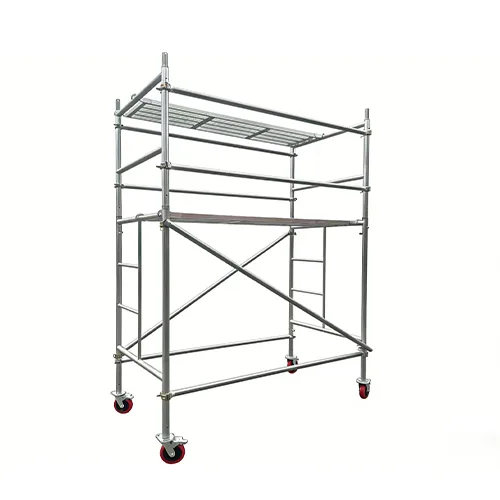
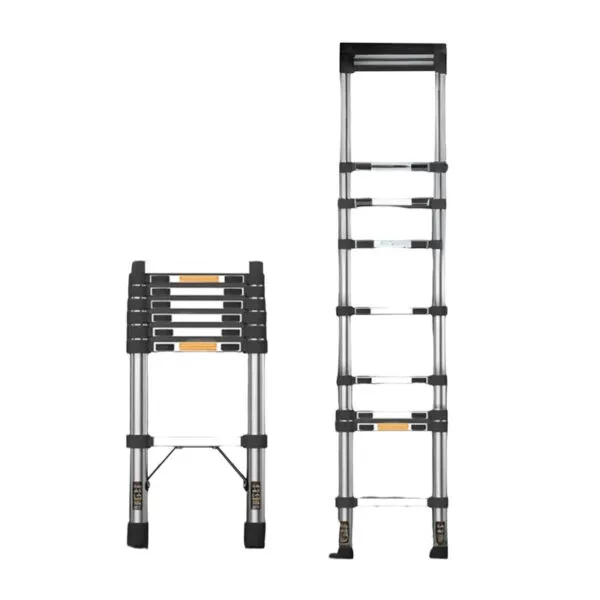
A ladder is not automatically the wrong choice. It remains practical for short-duration access, inspection, and simple tasks where the worker can maintain an appropriate position.
However, a scaffold is often more suitable when the job requires a stable platform, materials at height, repeated movement, or longer working periods.
| Comparison Factor | Indoor Scaffolding | Ladder |
|---|---|---|
| Working area | Wider elevated platform | Small standing area |
| Horizontal movement | More practical within the platform length | Usually requires repositioning |
| Tool storage | Can accommodate tools within rated limits | Very limited |
| Two-handed work | Generally more practical | Depends on ladder type and task |
| Setup | Requires correct assembly and inspection | Usually faster for simple access |
| Mobility | Mobile versions can be repositioned | Lightweight models are easy to carry |
| Space required | Requires more floor space | Suitable for tighter areas |
| Best application | Longer, repetitive, or material-intensive work | Short and simple access tasks |
| Initial cost | Usually higher | Usually lower |
| Training needs | Assembly and use procedures are essential | Correct ladder training is still required |
For a more detailed comparison, read Zichen’s guide to mobile scaffolds versus ladders.
When Does a Ladder Still Make Sense?
A ladder may be sufficient for a brief inspection, changing a light fixture, or reaching a location where a scaffold cannot fit.
The decision should be based on a task-specific risk assessment rather than convenience alone.
When Is Indoor Scaffolding the Better Choice?
A scaffold is commonly preferred when workers must remain elevated for an extended period, use both hands, carry several tools, or work across a wide wall or ceiling area.
It can also be a better operational choice when the same height must be maintained across several adjacent work zones.
Common Types of Indoor Scaffolding
Understanding the main configurations helps buyers avoid choosing a system that is either unnecessarily large or too limited for the job.
Mobile Scaffold Towers
A mobile scaffold tower uses wheels or casters to support movement across a suitable floor surface. It is frequently used in warehouses, halls, workshops, retail spaces, and commercial interiors.
Buyers should evaluate base dimensions, tower height, stabilizers, platform access, caster rating, and guardrail configuration.
Best For
- Ceiling installation
- Warehouse maintenance
- Electrical and mechanical work
- Large interior painting projects
- Lighting and signage installation
Folding Scaffolding
Folding scaffolding is designed for quick opening, closing, transport, and storage. Its compact structure can be useful for contractors who move frequently between smaller projects.
It is commonly considered for residential decoration, repair work, painting, and low-to-medium-height maintenance.
Best For
- Residential interiors
- Repair contractors
- Painting crews
- Short-duration maintenance
- Projects with limited storage space
Frame Scaffolding
Frame scaffolding uses prefabricated welded frames connected by cross braces and platforms. It can provide a practical balance between assembly speed, stability, and working area.
For interior use, buyers should confirm that the frame dimensions are compatible with doors, corridors, elevators, and available floor space.
Ladder Scaffolding
Ladder scaffolding combines access and platform functions in a compact arrangement. It can be useful for lighter maintenance and installation tasks where a full tower is unnecessary.
Learn more in Zichen’s article about ladder scaffolding for indoor and outdoor tasks.
Modular Scaffolding Systems
Modular systems are assembled from standardized components and can be adapted to different heights, lengths, and layouts.
They are often selected for larger interior projects, industrial facilities, complex ceiling work, and situations requiring multiple working levels.
What Jobs Can Indoor Scaffolding Be Used For?
Indoor systems are used in both construction and ongoing building maintenance.
Painting and Wall Finishing
A longer platform allows painters to cover a wider wall section while keeping brushes, rollers, and smaller materials within reach.
This can be especially useful in stair halls, reception areas, auditoriums, and rooms with high ceilings.
Drywall and Ceiling Installation
Drywall work requires workers to handle boards, tools, fasteners, and finishing materials. A properly selected platform provides more working space than a basic ladder.
The scaffold’s load rating must account for workers, tools, and all materials placed on the platform.
Electrical and Lighting Work
Electricians use elevated platforms for cable trays, lighting fixtures, conduits, sensors, and ceiling-mounted equipment.
A stable working level can be valuable when tasks require precision or extended overhead work.
HVAC and Fire Protection Systems
Ducts, vents, pipes, sprinklers, and mechanical components are often positioned above ceilings or in high interior spaces.
Mobile towers can help maintenance teams move systematically through large facilities.
Warehouse and Industrial Maintenance
Warehouses and production buildings frequently contain high lighting systems, ventilation equipment, storage structures, and utilities.
A reusable scaffold system can support planned maintenance as well as occasional repair work.
How to Choose Indoor Scaffolding
Choosing indoor scaffolding should begin with the job requirements rather than a preferred product type.
The following factors influence safety, usability, transportation, and total ownership cost.
Measure the Available Space
Check ceiling height, doorway width, corridor width, elevator dimensions, and the scaffold’s assembled footprint.
Also consider base extensions, outriggers, access zones, and the space needed for assembly.
Confirm the Required Working Height
Working height is not always the same as platform height. Working height generally includes the worker’s reach above the platform.
Buyers should confirm how the manufacturer defines each measurement before comparing models.
Calculate the Intended Load
The total load may include:
- Workers
- Hand tools
- Equipment
- Paint or installation materials
- Components temporarily placed on the platform
Never estimate capacity based only on visual appearance. Review the manufacturer’s rated load and applicable local requirements.
Evaluate the Platform
The platform should be compatible with the scaffold system and appropriate for the intended application.
When selecting a work surface, compare material, dimensions, locking method, slip resistance, durability, and load rating. Zichen’s guide on how to choose scaffolding planks provides additional purchasing considerations.
Examine the Access Method
Workers need a safe way to enter and leave the platform. Depending on the design, access may be provided by an integrated ladder, stair section, access frame, or hatch platform.
Climbing cross braces or using improvised access methods should not replace the intended access system.
Check Mobility Components
For a mobile scaffold, examine caster diameter, wheel material, brake design, stem compatibility, load capacity, and suitability for the floor.
Larger wheels may cross small surface irregularities more easily, but wheel size alone does not make an unsafe surface suitable for movement.
Review Storage and Transportation
Folding dimensions and component weight matter to service contractors who transport equipment between projects.
A compact system may reduce vehicle space and simplify warehouse storage, but it must still meet the project’s height and load requirements.
Indoor Scaffolding Safety Concepts
Equipment selection alone cannot guarantee safe operation. Assembly, inspection, training, floor conditions, load management, and worker behavior are equally important.
In the United States, users can consult the official OSHA scaffolding requirements and OSHA’s guidance for supported mobile scaffolds.
Competent Person
A competent person is responsible for identifying existing and predictable hazards and has the authority to take corrective action.
Responsibilities and terminology may vary between jurisdictions, so project managers should verify the rules that apply to the job location.
Stable Foundation
The floor must be capable of supporting the scaffold and intended load without settlement or uncontrolled movement.
Uneven, damaged, sloped, obstructed, or contaminated surfaces may require corrective measures before assembly or relocation.
Component Compatibility
Frames, braces, platforms, guardrails, pins, casters, and connectors must form a compatible system.
Mixing unrelated components can create alignment, locking, load-transfer, or stability problems.
Pre-Use Inspection
A scaffold should be inspected before use and after events that may affect its structural condition.
Inspection points typically include connections, braces, platforms, access components, guardrails, casters, brakes, damage, deformation, corrosion, and overall stability.
Controlled Movement
Mobile scaffolds should be moved only according to applicable regulations and manufacturer instructions.
OSHA states that mobile scaffolds must be stabilized to prevent tipping during movement. The route should also be checked for holes, obstructions, slopes, overhead hazards, and other unsafe conditions.
What Features Are Professionals Prioritizing in 2026?
Buyers are increasingly looking beyond basic frame dimensions.
They want systems that can support efficient deployment, consistent inspection, replacement-part availability, and use across multiple projects.
Tool-Free or Reduced-Tool Assembly
Simple connection methods can reduce setup complexity and the number of loose tools needed during assembly.
However, fast assembly must never replace correct locking, bracing, inspection, and training.
Modular Expansion
Expandable systems allow buyers to add frames, braces, platforms, guardrails, or other approved components as project needs develop.
This can be more economical than purchasing a completely different system for every working height.
Replaceable Components
Casters, platforms, pins, braces, and guardrail components may experience different levels of wear.
A system with identifiable and replaceable parts can be easier to maintain over its service life.
Surface Protection
Indoor projects often involve tile, finished concrete, wood, resin flooring, or other completed surfaces.
Wheel material, load distribution, debris control, and protective procedures should be considered before moving or installing equipment.
Traceability and Documentation
Professional buyers may request technical specifications, product identification, testing information, packaging details, inspection guidance, and applicable certification documents.
Zichen’s scaffolding certification guide explains why documentation and training are increasingly important in modern project management.
Buying vs Renting Indoor Scaffolding
The right commercial decision depends on utilization, storage capacity, transportation, maintenance resources, and project duration.
| Decision Factor | Buying | Renting |
| Frequent use | Often more economical | Repeated fees may accumulate |
| One-time project | Higher upfront investment | Usually more practical |
| Equipment availability | Available when maintained and stored | Depends on rental inventory |
| Configuration choice | Buyer controls the system | Limited to available models |
| Maintenance | Owner’s responsibility | Often managed by rental provider |
| Storage | Requires dedicated space | Returned after use |
| Custom requirements | Easier to standardize a fleet | May be difficult to source |
| Long-term cost | Potentially lower with high utilization | Potentially lower with limited use |
Who Should Consider Buying?
Painting companies, facility maintenance teams, electrical contractors, HVAC installers, drywall contractors, and equipment rental businesses may benefit from ownership when utilization is predictable.
Buying also allows a company to standardize training, inspection procedures, spare parts, and system configurations.
Who Should Consider Renting?
Renting may suit one-time renovation projects, emergency repairs, or jobs requiring a configuration that is unlikely to be used again.
Before renting, confirm delivery conditions, inspection responsibilities, component compatibility, damage policies, and training requirements.
How Do You Find a Reliable Indoor Scaffolding Supplier?
A supplier should be evaluated on more than unit price.
Product consistency, documentation, manufacturing control, packaging, replacement components, technical communication, and delivery capability can all affect the final project outcome.
Ask Specific Questions
Instead of asking only, “How much does it cost?” buyers can ask:
- What is the rated platform load?
- Which components are included in the quotation?
- Are guardrails, access ladders, platforms, braces, and casters included?
- What are the packed dimensions and shipping weight?
- Can the scaffold pass through a standard doorway?
- Which standards or testing requirements apply to this model?
- Are replacement parts available?
- Can the configuration be customized?
- What surface treatment is used?
- What inspection and maintenance information is provided?
Compare Complete Configurations
A low quotation may exclude platforms, guardrails, stabilizers, access components, or transport packaging.
Compare complete working systems rather than comparing one frame price with another supplier’s full scaffold package.
Review Manufacturing Capability
Zichen Building Materials supplies complete scaffolding and shoring solutions, including scaffolding systems, steel planks, couplers, steel props, jacks, ladders, and accessories.
For project-specific dimensions, loading requirements, quantities, packaging, or export information, buyers can contact the Zichen team for a detailed quotation.
Frequently Asked Questions About Indoor Scaffolding
Is indoor scaffolding safer than a ladder?
Neither option is automatically safe in every situation. A scaffold generally provides a wider working platform and may be more suitable for longer or two-handed tasks, while a ladder may be appropriate for short-duration access.
The safest choice depends on the task, height, duration, floor condition, load, training, equipment condition, and applicable regulations.
What type of scaffold is best for indoor painting?
A folding scaffold or mobile scaffold tower is often practical for indoor painting because it can provide a wider work area and be repositioned between sections.
The ideal model depends on ceiling height, wall length, doorway dimensions, working load, and floor protection requirements.
Can you move indoor scaffolding while someone is standing on it?
Moving an occupied scaffold can create serious tipping and fall hazards. Follow the applicable regulations and the manufacturer’s instructions rather than assuming that occupied movement is permitted.
OSHA places specific conditions on mobile scaffold movement and requires mobile scaffolds to be stabilized against tipping.
Will a mobile scaffold fit through a standard doorway?
Some compact and folding models are designed to pass through common door openings, but dimensions vary.
Check the scaffold’s overall width, caster position, folded size, stabilizers, and whether partial dismantling is required.
How high can indoor scaffolding go?
The allowable height depends on the scaffold design, base dimensions, manufacturer instructions, configuration, stabilizers, ties, loading, and local regulations.
Do not add frames or components beyond the approved configuration simply because the ceiling is higher.
What floor is suitable for a mobile indoor scaffold?
The supporting surface should be firm, capable of carrying the load, and suitable for assembly and movement.
Inspect the route for slopes, openings, debris, cables, damaged flooring, thresholds, and other obstructions before moving the scaffold.
Do indoor scaffolds need guardrails?
Guardrail and fall-protection requirements depend on the platform height, scaffold type, work environment, and local regulations.
Users should follow the manufacturer’s instructions and verify the legal requirements for the country or region where the scaffold will be used.
How much weight can indoor scaffolding hold?
Capacity varies by product and configuration. The rated load must cover workers, tools, equipment, and materials placed on the platform.
Always obtain technical load information from the manufacturer and never exceed the lowest-rated component in the system.
Is aluminum or steel indoor scaffolding better?
Aluminum is generally lighter and can be easier to carry, while steel systems are often selected for durability, rigidity, and demanding working environments.
The better choice depends on transport frequency, load needs, exposure conditions, budget, dimensions, and maintenance procedures.
Can indoor scaffolding damage finished floors?
Wheels, concentrated loads, trapped debris, and uncontrolled movement can damage sensitive surfaces.
Before installation, assess the flooring material and use project-approved protective measures that do not compromise scaffold stability.
Final Thoughts
Professionals are choosing indoor scaffolding in 2026 because interior projects demand more than simple access to height. Contractors need stable working areas, efficient movement, configurable heights, organized tool access, and equipment that can support repeated use across different sites.
A mobile, folding, frame, ladder, or modular scaffold can improve workflow when it is correctly matched to the project. However, purchasing decisions should always consider dimensions, intended load, platform design, access, caster quality, component compatibility, documentation, and local safety requirements.
For contractors, distributors, facility managers, and rental companies, the best solution is not necessarily the tallest or least expensive model. It is the system that fits the building, supports the intended task, meets relevant requirements, and remains practical throughout its working life.
Explore Zichen’s complete scaffolding product range or request a project-specific quotation to compare suitable configurations for your market and application.
Thank you for reading! We hope our insights help you work safely and efficiently with frame scaffolds and other construction equipment. For more updates, tips, and discussions, connect with us on Facebook. Join our community to stay informed, share experiences, and engage with fellow professionals in the scaffolding industry.